Back to Events
Workshop
Build Your First AI Agent in 60 Minutes
Zero to working AI agent in one hour. Fork the repo, run it, put it on your resume.
Sun, 9 Aug, 08:00 pm – 08:59 pmOnline Event6 / 50 registered
Event Timeline
What is an AI agent? Real examples
Sun, 9 Aug, 08:00 pm – Sun, 9 Aug, 08:10 pm
Fork template + environment setup
Sun, 9 Aug, 08:10 pm – Sun, 9 Aug, 08:25 pm
Build the Researcher agent
Sun, 9 Aug, 08:25 pm – Sun, 9 Aug, 08:40 pm
Build the Writer + Reviewer agents
Sun, 9 Aug, 08:40 pm – Sun, 9 Aug, 08:50 pm
Run the full crew on a live topic
Sun, 9 Aug, 08:50 pm – Sun, 9 Aug, 08:56 pm
Q&A + how to customize it
Sun, 9 Aug, 08:55 pm – Sun, 9 Aug, 08:59 pm
About This Event
What You Will Build
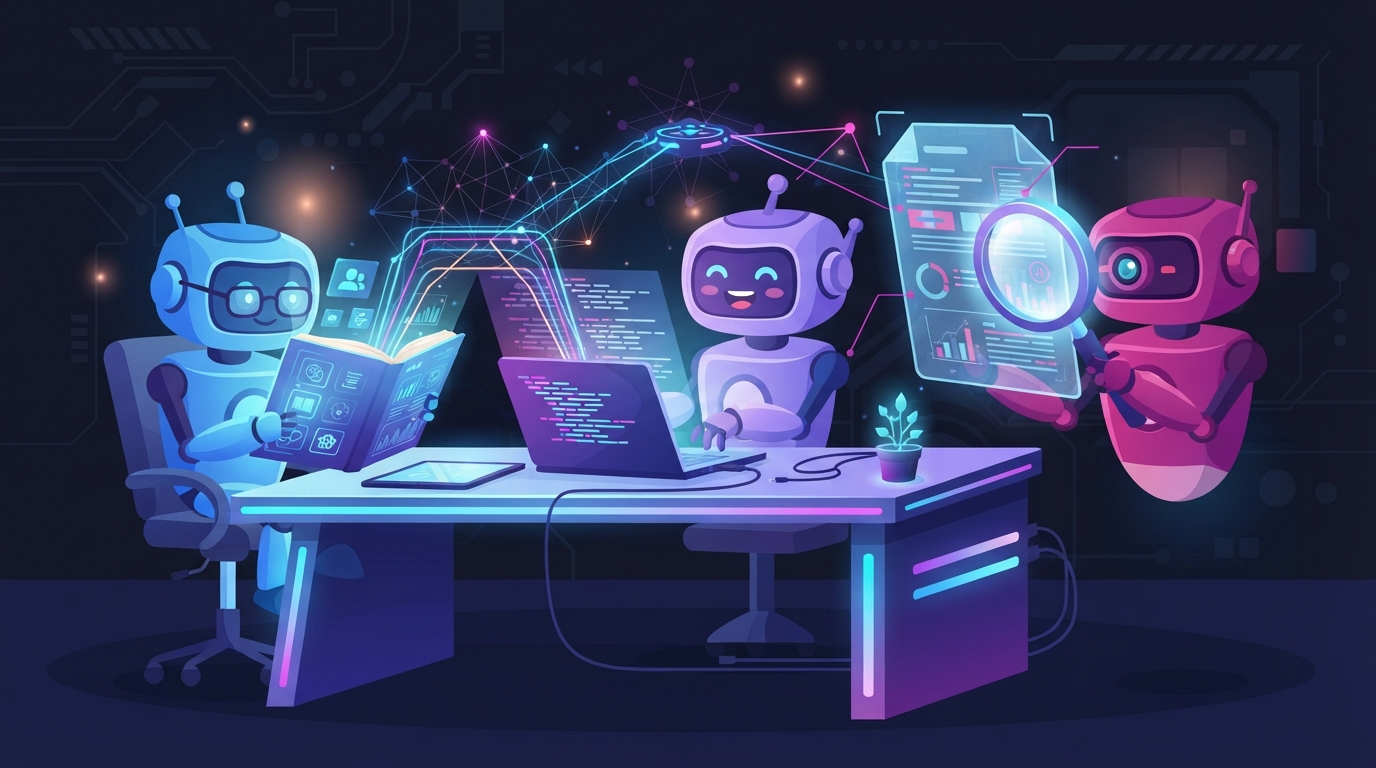
By the end of this session, you will have a Research & Write Crew — a multi-agent system that mirrors how real engineering teams divide work.
| Agent | Role | What It Does |
|---|---|---|
| Researcher | Information gatherer | Searches the web, collects facts, and returns structured findings on any topic |
| Writer | Content producer | Turns raw research into a clear, blog-style summary |
| Reviewer | Quality gate | Checks accuracy, flags weak claims, and suggests improvements before output ships |
This is not a toy demo. It is the same research → build → review loop you will use in internships, hackathons, and production codebases — except here, each role is an AI agent you configured yourself.
You fork a template, run it locally, and push the result to GitHub. In 60 minutes, you go from "I have heard of AI agents" to "I built one."
Why This Matters for Engineering Students
Every engineering student learns loops, functions, and data structures. Very few leave college having shipped something that uses AI in a real workflow.
That gap shows up immediately in interviews:
"Tell me about a project where you used an API."
"Have you worked with LLMs or agent frameworks?"
"How do you break a complex task into smaller parts?"
This workshop gives you a direct answer to all three — in one afternoon.
What changes for your career
- You stop being a tutorial consumer. Forking, running, and modifying a repo is how engineers actually work. This session trains that muscle, not just the syntax.
- You speak the language companies are hiring for. Agentic AI, multi-step workflows, and API integration are showing up in job descriptions across backend, full-stack, and ML-adjacent roles — even at the intern level.
- You get a project worth showing. A GitHub repo with a working multi-agent crew is more convincing than another "To-Do app in React" on a resume that looks like everyone else's.
- You build confidence before the hard stuff. You do not need to understand transformers or embeddings today. You need to understand: agent = role + goal + tool. That mental model unlocks everything that comes next.
The industry connection
Companies do not hire students for what they memorized. They hire for what they can demonstrate.
When you walk into an interview and say "I built a three-agent CrewAI system that researches a topic, writes a draft, and reviews its own output — here is the repo", you are not listing a skill. You are proving you can:
- Integrate third-party APIs under time pressure
- Design a system with clear separation of concerns
- Ship something end-to-end, not just write code in a notebook
That is the difference between a student who applied and a student who gets called back.
Skills You Will Carry Into Industry
| Skill | Where You Use It |
|---|---|
| API integration | Every modern backend — payments, auth, LLMs, cloud services |
| Multi-agent design | Automation pipelines, CI/CD, microservices, AI product features |
| Prompt engineering | Getting reliable output from LLMs — a skill hiring managers now explicitly ask for |
| Git workflow | Fork, clone, commit, push — non-negotiable in any engineering team |
| Debugging live systems | When your agent returns garbage, you learn to trace the problem — not restart the tutorial |
These are not "AI buzzwords." They are the same building blocks used in production systems at startups and large tech companies today.
Prerequisites
You do not need an ML background. You need a laptop and willingness to type along.
| Requirement | Notes |
|---|---|
| Python installed | Basic familiarity is enough — if you have written a function and imported a library, you are ready |
| OpenAI API key | Free tier works for the workshop; we walk through setup live |
| GitHub account | Used to fork the template and push your finished agent |
Stuck on setup? That is normal. Mentors will pair you with someone who got it working — asking for help early is exactly what engineers do on day one of any job.
Post-Workshop: Turn This Into Career Momentum
Do not let this sit as a folder on your desktop. The students who move fastest treat every workshop as a launchpad.
- Push your agent to GitHub — Make the repo public. Add a README that explains what each agent does in two sentences. Recruiters click repos; give them something to see.
- Write a 2-line LinkedIn post — "I built my first AI agent today using CrewAI. Three agents: one researches, one writes, one reviews. Link to repo below." Visibility compounds. Post the same week you build.
- Join Challenge 1 (AI Resume Builder) — The skills from this workshop — API calls, structured output, agent logic — are exactly what Challenge 1 requires. You will not be starting from zero.
- Add it to your resume — One bullet under Projects: "Built a multi-agent research crew with CrewAI (Python, OpenAI API) — automated web research, content drafting, and quality review."
The workshop ends in 60 minutes. Your career leverage from it lasts much longer — if you ship, share, and keep building.
Mentor Briefing (Internal)
- Do not explain transformers or embeddings. Students don't need it yet.
- Focus on: "agent = role + goal + tool" — repeat this until it sticks.
- If someone gets stuck on API keys, pair them with a neighbor who got it working.
- The goal is confidence, not expertise — one working agent beats one perfect explanation.
- Remind students: this project goes on GitHub and LinkedIn the same day. Help them feel proud of what they built.
Quick Info
Date
Sun, 9 Aug, 08:00 pm – 08:59 pm
Location
Online Event
Attendees
6 / 50 registered